


Do You Need Instagram's AI Label If You Only Edit?
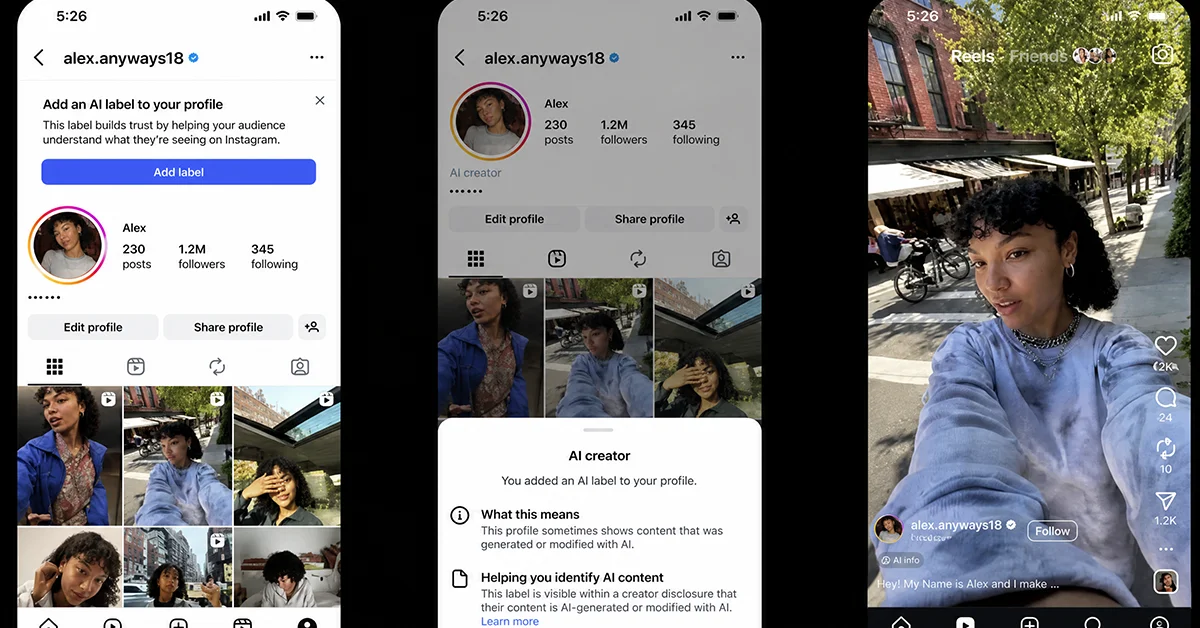
The line Instagram drew is about who appears in your content, not which tools made it.
No. Instagram's 31 August 2026 creators blog post says that creators who simply use AI tools as part of their creative process do not need to add the label. The AI-generated profile label is aimed at accounts that regularly post content featuring an AI-generated person instead of a real human.
So the test is about the face on screen. A photographer who runs every frame through an AI editor is still a photographer, and the person in the pictures is still real. An account built around a woman who does not exist is a different case, even when a whole team of real people writes her captions and books her sponsorships. Who operates the account is not the question Instagram is asking.
Enforcement has not started yet. Press coverage of the announcement says the profile toggle has reached accounts and creators can switch it on. Instagram has not begun detection or the notices that go with it, as of 2 September 2026.
What the AI-Generated Profile Label Actually Covers
An AI-generated profile label is a profile level marker telling viewers that the person featured in an account's content is AI-generated rather than a real human. Instagram's Help Centre definition frames it as an account that regularly posts content featuring an AI-generated person instead of a real human. That sentence carries the whole scope.
The 31 August 2026 announcement also renamed the old marker. What was called the AI creator label became AI-generated profile, with the stated reason being clarity about when a profile features an AI-generated person rather than a human. Instagram lists three places the label can surface, and none of them is buried. One is next to the profile itself, on the profile page or in search. Another sits beside the account's content in feed, Reels and Stories. The third appears next to the account's comments or messages. One priority rule applies. If a piece of media already carries the AI content label, the profile label does not appear a second time beside it.
| Account setup | Does the profile label apply | Reason |
|---|---|---|
| A real photographer who retouches every shot with AI editing tools | No | The person shown in the content is a real human |
| A real creator who drafts captions with an AI writing assistant | No | Tool use inside the creative process is exempt |
| An account whose posts feature a computer-generated woman who does not exist | Yes | The person featured is AI-generated rather than real |
| A real person managing an account that posts AI-generated characters | Yes | The criterion is who appears, not who operates |
| A real creator who fronts videos with an AI avatar of themselves | No published rule | Instagram has not addressed hybrid setups |
Where Does Tool Use End and AI Identity Begin?
Tool use ends at the point where the person on screen stops being a real human. Everything before that line, from generative fills to voice cleanup to an AI assistant rewriting a caption, sits inside the creative process that the 31 August 2026 announcement explicitly puts outside the label.
Take a food creator who films her own hands and face, then generates a marble backdrop because her kitchen counter is chipped. Her audience is watching a real person cook. Now take a fashion account whose model has never existed, photographed in cities she has never visited. The second account is the one the policy describes, and the difference has nothing to do with how much software each of them used.
The tidy examples circulating in coverage of the announcement, things like photo retouching, caption polishing and graphic design, are press illustrations rather than official text. Instagram's own wording is broader and shorter. It exempts AI tools used as part of a creative process without listing which tools qualify. That leaves a grey band in the middle, and the people standing in it are usually the ones asking the question in the first place.

Is the Label Mandatory or Recommended?
Recommended. The verb pair Instagram uses is can and should, both in the 31 August 2026 creators blog post and in the softer Help Centre phrasing, where creators can add the label. Neither "must" nor "required" appears anywhere in Instagram's own text about the profile label.
The word "required" does appear in Meta's labelling rules, but at a different level. Post level AI content labelling is required for photorealistic video and realistic-sounding audio, and not for still images. Two systems, two vocabularies. The stricter word belongs to the one about individual posts.
| Instagram's own wording | How it commonly gets reported |
|---|---|
| Creators "can and should" apply the label | Creators are obliged to add the label |
| Unlabelled AI profiles "may see limits" to reach | Reach is cut off |
| Accounts become "ineligible to appear in recommendations" | Accounts get closed or suspended |
| Creators who add the label proactively "will not see a change" to reach | Labelling yourself damages your account |
Transparency around synthetic media is under pressure from several directions at once, and platforms are moving at a moment when regulatory attention on AI disclosure is rising. Instagram cited no legislation in its announcement. Treat the timing as context rather than cause.
What Happens to Accounts That Skip It?
An AI-generated profile that does not add the label may become ineligible to appear in recommendations until the label goes on. Instagram announced that consequence in conditional language, and it stops there.
The announcement mentions no account closure. It does not say that a profile stops reaching anyone. The mechanism it names is recommendation eligibility, a distribution setting rather than a switch that turns an account off. Instagram also says unlabelled profiles it detects will be notified and can check Account Status. The restriction is meant to be visible to the account holder rather than silent.
Two things get overstated constantly. The first is the specific surface list. You will read that Explore, Reels and feed suggestions are individually affected, and that breakdown comes from press interpretation of the 31 August 2026 announcement rather than from Instagram, which says only "recommendations". The second is timing. Instagram is enforcing nothing yet as of 2 September 2026, and it has published no detection method and no frequency threshold.
If you are a real creator who posts your own face and uses AI tools to speed up editing, none of this is aimed at you. If you have spent the week worrying about filters, you can stop.
Does Adding the Label Cost You Reach?
No. Instagram's 31 August 2026 creators blog post states that creators who proactively add the AI-generated profile label will not see a change to their profile's reach. Disclosure is free.
Compare Spotify. Its AI Persona badge, announced on 11 August 2026, removes labelled accounts from editorial and algorithmic recommendations by default. On that platform, telling the truth about a synthetic performer costs you the recommendation surfaces immediately. Instagram inverted the incentive. Silence carries the risk, and the label protects standing.
| Platform and announcement | Effect of the label on recommendation eligibility |
|---|---|
| Instagram AI-generated profile label, announced 31 August 2026 | Profiles that add the label proactively see no change to profile reach; unlabelled AI-generated profiles may become ineligible for recommendations |
| Spotify AI Persona badge, announced 11 August 2026 | Labelled accounts are removed from editorial and algorithmic recommendations by default |
For anyone running a synthetic persona account across both platforms, that is two opposite calculations from the same disclosure decision. The same admission would protect a virtual musician's reach on Instagram and cost it on Spotify. Nobody has reconciled those incentives, so operators are deciding one platform at a time.
How Is This Different From the Post Level AI Label?
They are two independent systems. One marks a piece of content, the other marks an account, and neither one triggers the other. Most confusion about this policy starts with treating them as a single thing.
The post level label describes how a specific image, video or Reel was made. The profile level label describes who the account presents to its audience. A real creator posting an AI-generated illustration might attract the first and never the second. A synthetic persona posting an ordinary photograph of a street could attract the second and not the first.
| Post level AI content label | Profile level AI-generated profile label | |
|---|---|---|
| What it marks | An individual post, Story or Reel | An entire account |
| What triggers it | Content was generated or altered with AI, detected via industry standard signals or self disclosure | The account regularly posts content featuring an AI-generated person instead of a real human |
| Disclosure expectation | Required for photorealistic video and realistic-sounding audio | Creators "can and should" apply it |
| Consequence of not labelling | Applies to the individual post | Profile may become ineligible for recommendations |
| Announced | April 2024, renamed July 2024 | 31 August 2026 |
The overlap rule matters in practice. Where a post already carries the content label, the profile label is not shown next to that post again. So an account can hold the profile label and still show a clean looking Reel, simply because the post already declared itself.
What Should a Brand Ask Before Working With an AI Persona?
Ask who appears in the content, whether the profile toggle is switched on, and how the disclosure will read inside the campaign itself. Those three answers settle most of the risk before anyone drafts a contract.
Beyond that, a short list of questions separates a professional AI persona operation from one that has not thought about any of this:
- Is the person featured in this account AI-generated, partly AI-generated, or a real human with heavy AI editing?
- Has the account added the AI-generated profile label, and if not, what is the reasoning?
- Which posts will carry post level AI content labelling, and who applies them?
- How will the persona be described in the sponsored post disclosure, separately from the platform label?
- Who is legally responsible for claims made by a character that cannot be deposed?
- If the account's recommendation eligibility changes mid campaign, what happens to the deliverables?
Put the answers in the brief rather than the group chat. Halfway through a campaign, a brand can discover that its partner's audience believed it was following a real person. At that point the problem is trust rather than policy, and the platform label will not fix it.
Measurement is the other half of the conversation. A brand reading a partner's recent posts is reading engagement numbers, and anyone who has run promotional spend on formats like Instagram like packages already knows that the figures under a post reflect budget, timing and format as much as audience appetite. Ask which posts were promoted and which grew on their own before you treat a chart as evidence of fit. Every partner account deserves that question, whoever or whatever fronts it.




Which Hybrid Setups Have No Rule Yet?
Most of the interesting ones. Instagram's Help Centre definition covers a profile featuring an AI-generated person instead of a real human, and the announcement covers creators using AI tools. Everything sitting between those two descriptions has no published rule as of 2 September 2026.
| Setup | What Instagram has published | Why it stays open |
|---|---|---|
| A real creator appearing through an AI avatar of their own face | Nothing specific | A real human is behind it and an AI-generated figure is on screen |
| Real footage with an AI-generated voice | Nothing specific | The person shown is real; the voice is not |
| A virtual mascot for a brand account | Nothing specific | No human is being impersonated |
| An illustrated or animated character | Nothing specific | The definition refers to an AI-generated person, not a drawn one |
| A parody or fan account using generated imagery | Nothing specific | Intent is transparent to the audience but the figure is synthetic |
| AI Studio characters run by a real account | Nothing specific | The relationship between the tool and the profile label is undefined |
Do not fill those blanks with confident answers you found somewhere. Nobody has them. Decide on a house rule instead and hold to it, so that your audience never learns something about your account from somebody else.
Disclosure discipline works as a habit rather than a one-off compliance chore. It means saying plainly what your audience is looking at, in the caption as well as in the toggle. Write it into your content brief alongside the sponsorship disclosure. Decide who checks it before a post goes out, and revisit it when the platform changes wording again. It will change again.
The creators who need to think hardest about all this are the ones building characters. Everyone else, the ones who just used an AI tool to fix the lighting on a Tuesday afternoon, can carry on.
This article was last updated on 13 October 2026 tuesday. Today, 16 visitors read this article.